
A walk in support of weather and climate science.
All opinions expressed on this site are personal.
25 min
All opinions expressed on this site are personal.
April 22 to May 22
Hi, I'm Syl! I'm an Earth Science PhD candidate studying aerosols -- tiny liquid and solid bits of matter in the atmosphere -- who recently walked from NYC to DC. Why did I do this? Well, to answer that, we need to go back to April 22nd, 2026.
On April 22nd, I received a message on my phone from Andrew Williams, whom I fondly co-hosted the opening of the Weather & Climate (WC) Livestream with in 2025 and who many have rumored to be my long-lost brother. :D Andrew noted in the WC Livestream organizing chat a few alarming facts:

With these facts in mind, Andrew suggested the need for a followup to last year's 100 hour Weather and Climate Livestream, which had been seen by nearly 200,000 people, and resulted in 30,000 calls to members of Congress detailing why climate and weather science is worth funding.
After a few organizing meetings discussing the ongoing urgency of this situation, I pitched walking from NYC to DC as a way to generate publicity, half jokingly. To my surprise, the idea generated some excitement! The organizing team graciously helped shape the idea into a physical manifestation of the Livestream's goal; instead of calling Congress, I would hand deliver real paper letters to members of Congress. To make matters more epic, a 50 hour livestream would still be planned to allow for maximum participation from the scientific community, coinciding with the final 50 hours of my walk to the Capitol Building!
Thrilled, I spent a good deal of time preparing and imagining what such a walk could shape up to be; how to best craft a narrative that would complement delivering letters to Congress. While an amazing crew of organizers were helping shape details for the 50-hour Livestream logistics (shout-out Andrew Williams, Jonah Bloch-Johnson, Paulina Czarnecki, Stella Heflin, and Clare Singer!), walk letter collection (shout-out Virginia Schutte!), walk letter handoff strategy (shout-out Haley Crim and Marc Alessi!), and overall social media strategy (shout-out Berenize Garcia Nueva and Heather Autumn!) the walk itself was largely up to me to plan. After chatting with some of my beloved friends and family, I settled on two main objectives:
With these objectives set, I then began the actual planning process. First, I needed a route. Luckily, I knew just the person. Jacob LD-- one of my best friends from college, had walked across the United States in 2024. I hopped on a Zoom call with Jacob, and together we created a first draft of a route--
Step one, done!
The next stage was a bit more tricky. Namely, brainstorming how to communicate weather and climate science along the way. I settled on the idea to attempt to set up in-person interviews with researchers and experts who were along the walking path, knowing it was a long shot for people to say yes. I reached out to 92 scientists along my planned route, of which 11 responded yes to an in-person interview... honestly... not a bad yield! (12%). Emails were tricky, as I had to provide the time I would be arriving, which relied heavily on the assumption my walk wouldn't be delayed. To work around this, I provided a 2-3 hour time window and a link to a group chat to communicate day-of to all the experts that agreed to take part.
Having secured the 11 interviews, I then procured 500 stickers, 25 vintage pins, and 20 embroidered hats to hand out along the walk. I figured having things to hand out would make conversing with folks a bit easier, and would be a way to thank the interviewers for their time. See below a cube full of merch images --
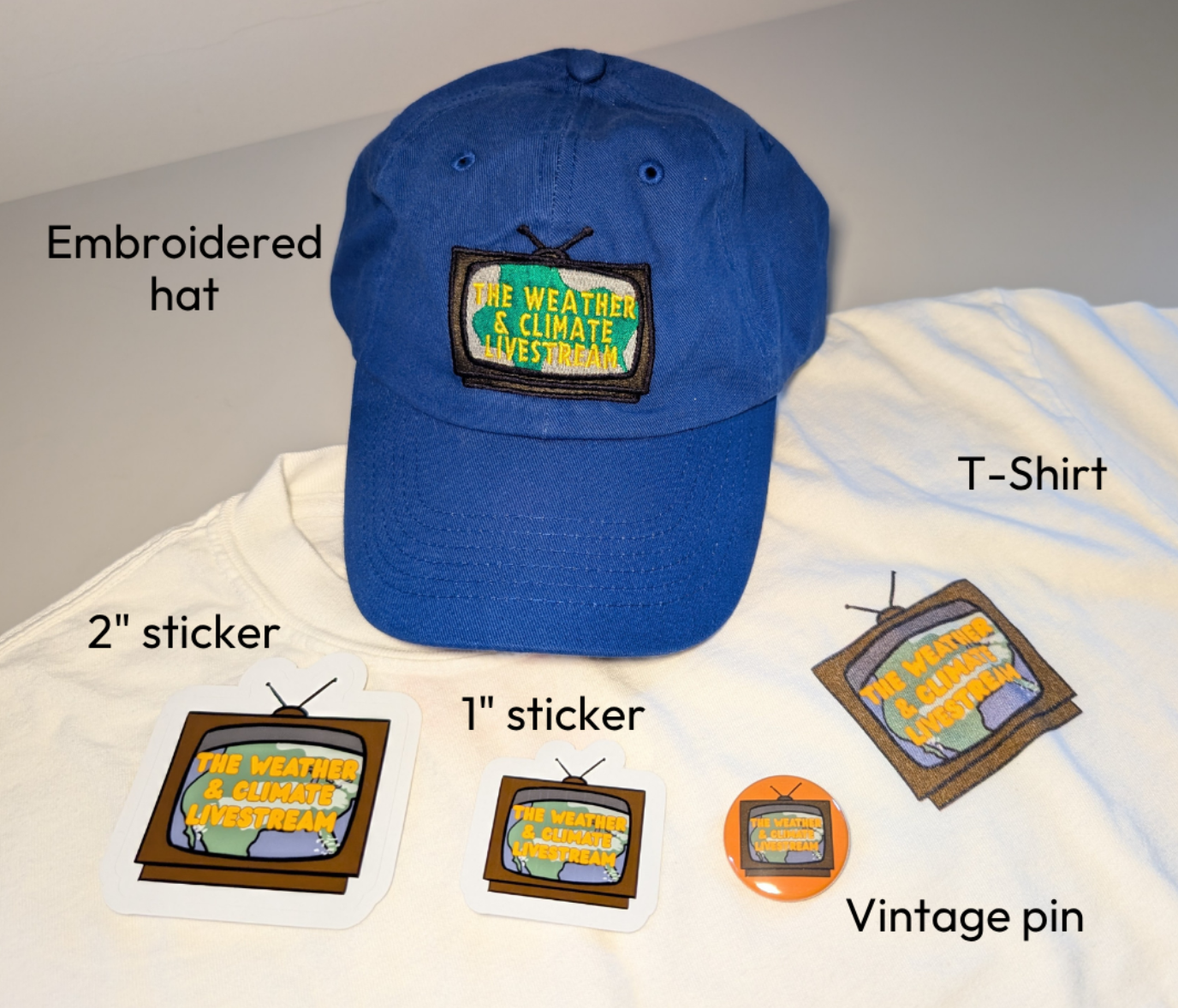
As the organizing pieces around the walk began to fall into place, some excitement grew within the organizing group, and I was lucky enough to help convince two other folks to join me on this journey. Miriam Nielsen, a climate science postdoc and legendary video creator (@zentouro), and Virginia Schutte, an award-winning freelance science communicator (@vgwschutte), volunteered to support me throughout the duration of the walk, helping with all things logistics and content. Them joining was a pivotal moment for the project. Right off the bat, Virginia made an impact, recruiting three additional interviews from folks she knew at Rowan University, bringing the grand total to 14. Miriam also made a quick impact, volunteering to bring along a full-amenities, tricked out, camping van, AKA "The Content Bus", as a place to create content along the way.
Momentum, momentum, momentum!
As the days approached, my anticipation grew, but to stay grounded, I wrote on a slip of paper my own personal goals for the walk-- I have had experience with social media, but not so much with talking to cameras (scary!!), so this was new ground for me. I wrote the words: wonder, excitement, positivity, and fun on this slip of paper, which I tucked into my wallet. I would aim to embody these words throughout the following 12 days of adventure...

That's enough preface from me though--
Let's walk from NYC to DC!!
Manhattan, NY
The walk began at 10:00 AM on May 23 at the Great Hill in Central Park, where roughly a dozen other weather and climate enthusiasts kindly joined me to brave the 2-3" of rain in the forecast.

Annika Horne, a documentary film maker, created a wonderful recap video of this sendoff, which you can view here, as we began our meander down Central Park and towards midtown Manhattan. To start things off with a bang, the walk's first official stop was at Hershey’s Chocolate World. Why a bang, do you ask? Because we each received free chocolate by walking through the door! Pro tip for anyone visiting New York. Talk about a walker's paradise. :)

Well-fueled from the chocolate, we continued down the spine of Manhattan, making a second stop at Tashkent Supermarket for lunch, before meeting Hikaru Wakeel Hayakawa for the opening expert interview of the walk. Hikaru, the executive director of Climate Cardinals, myself, and co-organizer of the 2026 WC Livestream and walk Berenize Garcia Nueva are friends from college, so this was a really fun reunion!

Watch interview #1 ft. Hikaru below!
I couldn't think of a better way to start the walk than with Hikaru's interview-- serving as a reminder that science is only as useful as it is understood. Inspired by Hikaru’s interview, this website is actively being translated into five languages: Malagasy, Spanish, French, Vietnamese, and Mandarin.
Towards the end of Hikaru's interview, the rain started to pick up. To see just how hard the rain was falling, you can click the button below to see the exact radar at this moment, and throughout the walk, courtesy of NOAA National Centers for Environmental Information data! The yellow-red colors represent heavier rain. Click "Loop" multiple times to change the playback speed, or view a specific timeframe using the slider!
Manhattan, NY
After the interview with Hikaru, a few folks peeled off to avoid the rain, but a few more joined, as the group continued the journey down to Battery Park, the site of interview #2 with Dr. Allegra LeGrande. Allegra helps organize Hike the Heights, and is a world renowned expert in past Earth climates-- perhaps the most on-brand expert of the entire project. Watch interview #2 ft. Allegra below!
Allegra's interview was meaningful for a number of reasons, perhaps most of all to me because it demonstrated how creative weather and climate scientists can be in their quest to study Earth's past. The fact that shells of creatures at the bottom of the ocean hold secrets about what the temperature was like up to billions of years ago is nothing short of mind blowing. After Allegra’s video, much of the group departed, with the rain picking up in intensity and the Upper Bay in sight, indicating the end of the Manhattan walking stretch. Just a handful of hardy folks continued with me across the Staten Island ferry to begin the next stretch of land.
Staten Island brought a new vibe, with lovely sidewalks and conversation drifting toward atmospheric radiation-- the study of how sunlight travels through Earth’s atmosphere. After an hour of animated lightwave discussion, the group had dwindled to just two: myself and co-Livestream organizer Virginia Schutte. Fortunately, we found some company at Mile 15, where we were introduced to what I like to think was Howard Fox, the turkey (Who knew Staten Island had turkeys?!).

Virginia and I chugged along until we reached a marathon's distance (26.2 miles!), and called it a day at the sight of an appealing looking restaurant called Cucumber Sushi & Salad Bar. Just before dinner, Virginia and I had our first introduction to the highly anticipated Content Bus-- which Miriam had picked up from Brooklyn and driven to meet us in. The rain had soaked through our clothes, so we were both freezing, and very grateful to be able to warm up over a nice meal. See how cold it was by clicking the temperature button below... data courtesy of Climate Data Online from NOAA's National Centers for Environmental Information!
The next morning, the rain was somehow even heavier, and it was a solo journey for me, as Miriam and Virginia got to working on creating the walk's first content-- some short videos you can see by clicking here or here! I was dropped off where we had made it to the day prior, and continued my trek southwest. For the final mile of Staten Island, I recorded a short summary video-- the first "vlog" of the trip. See below!
This concluded the Staten Island section of the trip!
Staten Island, NY
Since there was no pedestrian friendly bridges to cross into New Jersey, I next received a ride from the Content Bus over the Eugenius Harvey Outerbridge, to be dropped off directly across the shore at the Raritan Bay Waterfront Park in South Amboy, NJ. Once in New Jersey, I continued the trek along the South Amboy roads, through Sayreville, and eventually through East Brunswick and Milltown, where I recorded a Mile 38 to 40 update below.
A few hours later, I found myself in North Brunswick Township, where at Mile 42, it was time for the Interview #3 of the walk-- this time, at a location a bit off the walking path. Miriam and Virginia picked me up, and we drove 15 minutes east to meet Dr. Alan Robock, a Professor at Rutgers University, at Monmouth Battle Monument in Freehold, NJ. This was a convenient location halfway between the walking path and where he was residing and we were thrilled he was able to work us into his schedule. Alan is a world-leading expert in nuclear winter research and all things climate and was a thrilling interview. Watch Interview #3 ft. Alan below!
Alan's interview was meaningful to me for a number of reasons, perhaps most of all because of how strongly he believes-- and has demonstrated-- the importance of scientists speaking out when they discover a potential danger to society. After meeting with Alan (and his amazing wife, who came along to support), I returned to the continuous footpath to complete another two miles, before calling it a day at 16 miles. What a start to the trip!
North Brunswick, NJ
The next morning, I got my earliest start yet (8:00 AM), and I began my traverse through the North Brunswick area of New Jersey, filled with wildlife and forest land-- the first quasi-rural portion of the trip. In this stretch, I saw people fishing, running, and enjoying the outdoors, and personally, it was really nice to take a few moments to re-set and center myself next to the flowing water of Davidson's Mill Pond Park.

I also saw the second wildlife of the trip, following the Staten Island turkey-- watch the video below to see!
After passing through South Brunswick Township, only Plainsboro Township remained between me and the next interview location, Princeton, NJ, 12 miles down the road. I hadn't expected any memorable moments to arise over this next stretch... however, that proved to be very false!
South Brunswick, NJ
After continuing a few miles down the road from Crossroads South Middle School, I was surprised to see an open door with a sign that said “Come on in!” and the smell of food... a walker’s dream. How could I not walk in? As it turns out, a Memorial Day ceremony had just ended at the Lt. John Farnkopf American Legion Post 401, and a reception was well underway. I walked in a bit hesitantly, but was quickly welcomed by a few organizers, and before I knew it, I was being provided with water bottles, snacks, and even a warm meal for the road. Inspired by the generosity of the folks, I gave out nearly 20 livestream stickers as a token of my appreciation.

During my time at the reception, I chatted with folks about my favorite ice nucleating bacteria, and the mission of the walk I was on. Many could not believe I had started in Central Park just a few days prior! I was very grateful for this stop, and it was one of the more memorable ones on the trip. It was also an honor to pay my respects for those who had served, and to their families.
After the Legion, I continued the journey south, where I filmed the first and only timelapse video of the trip, using a GoPro Virginia kindly lent me. In the video, you'll hear one of my Mom's fiddle tunes, which I was listening to on this section! In the beginning of the video, you can also see a point of view of me filming a short video on ice nucleating bacteria-- a video made better from the feedback I received from the folks at the Legion whom I had practiced on a few miles before (They were so kind to me!).
The next few miles went quickly, and I soon found myself in Princeton, NJ.
As I arrived to the final destination of the day, the Geophysical Fluid Dynamics Laboratory (GFDL), I was thrilled be greeted with the first ray of sunshine of the entire trip, which I documented in the video below.
Upon my arrival, I was truly exhausted, as some of the early adrenaline had started to wear off. Fortunately, a federal research scientist, Dr. Nadir Jeevanjee, offered to host me and the rest of the content crew for a night, which boosted my spirits in a major way. Below, you can see an image of me editing the ice nucleating bacteria video I mentioned, while rolling out my back at Nadir's house!

Arriving at Nadir's house was wonderful for a multitude of reasons, two of which I want to highlight here. Firstly, Dr. Andrew Williams -- lead organizer of the WC Livestream, incoming Columbia University Earth Science Professor, and person who helped inspire this entire walk -- arrived to join me for the following day's walk. Secondly, we all had an incredible daal dinner provided by Nadir and his family-- the best meal by far of the trip.
1/5th of the walk done!!
Princeton, NJ
The morning after the best sleep so far on the trip (another shout-out to Nadir!). I returned to Forrestal Road for Interviews #4, 5, and 6 of the walk. The first was with Dr. Mitch Bushuk, a GFDL scientist who is a world renowned expert in polar climate and sea ice prediction. In the interview, Mitch eloquently breaks down what a climate model really is. Watch Interview #4 ft. Mitch below!
Mitch's interview was something I wish I had watched before starting my PhD, as understanding a climate model can be extremely tricky-- they can be over a million lines of code! Mitch's testimony about the federal budget cuts was also extremely poignant, specifically how they are negatively impacting the quality of forecasts GFDL is able to produce. Following Mitch, interview #5 of the trip was with Dr. Tim Merlis, a GFDL scientist who is a world leading expert in the circulations of atmospheres both on Earth and on other planets throughout the Universe. Watch Interview #5 ft. Tim below!
Tim's interview was thrilling, and was a great example in my opinion of the serendipity of research. Namely, building climate models for Earth has helped us better identify which planets throughout the universe may house life! Another highlight was how he meticulously breaks down how counter-factual scientific inquiries are made possible by employing models. With these two incredible GFDL interviews completed, the next was with Bernadette Woods Placky, a globally acclaimed meteorologist and climate expert. Watch Interview #6 ft. Bernadette below!
Bernadette has been a hero of mine for a few years, so this interview was extra special. Additionally, I think her interview was an amazing example of how collaborative the weather forecasting process is-- you need input from observations, models, and interpretations from experienced humans working together to create the very best forecasts. This seamless collaboration that occurs behind the scenes is undoubtedly a great example of why the US has been a world leader in weather and climate science for all these years. Lastly, in honor of Bernadette's pro tip about paying attention to dew point, I've added in a feature to visualize the dew point for each and every moment of the walk below, with data again courtesy of Climate Data Online from NOAA's National Centers for Environmental Information!
Pro tip: Click the "Loop" button a few times until you reach the 16x playback-- check out how the dew point dances over the Great Lakes!

Following these wonderful interviews, it was time to continue my journey. Nadir, acclaimed federal research scientist and host of the content crew the previous day, was set to meet me at the Institute Pond, four miles south, for Interview #4 of the day, and #7 of the trip overall. For this stretch, Tim graciously joined to show me a scenic path on the route over. Watch this fun stretch with Tim below!
It was incredible to have Tim join me for the section, and we made it in no time to Institute Pond for Nadir's interview.
Princeton, NJ
Upon arriving at the Institute Pond, it was exciting to see the historic Fuld Hall overlooking the water. To hear more about Fuld Hall, Nadir's interview is a must-watch. Nadir is a world renowned expert in atmospheric radiation, and part of his research was actually the basis of one of the classes I’ve taken in grad school. This expertise on radiation, coupled with his expertise on the history of weather and climate forecasting, made this one of the more memorable interviews of the entire trip. Watch Interview #7 ft. Nadir below!
Nadir's interview was powerful for so many reasons, but one that stands out to me is just how accurate climate forecasts have historically been. Whether it's the sensitivity of Earth's temperatures to carbon dioxide, or Arctic amplification-- it's uncanny how well humans have been able to predict future climates. I would be remiss to also not mention that Nadir is a co-founder of one of my favorite organizations, Climate Up Close-- whose work largely inspired my approach to this project. After Nadir's interview, it was 1:30 PM, and there was still another 24 miles to walk in the day. It was time to get moving. Fortunately, reinforcements were brought in to keep momentum going. Namely, one Dr. Andrew Williams. See the first few miles of Andrew and me traversing the Institute Woods pathways in the video below!
With Andrew by my side, the miles went a bit faster. It was extremely fun to discuss clouds, and we even saw a beautiful heron swoop over the Delaware and Raritan Canal State Park Trail. After the canal trail, we emerged onto the streets of Lawrence Township, where I was thrilled to be able to hand out more WC Livestream stickers at various chance encounters with folks. One standout instance was with a sales associate at EZ-Go mart. In our conversation, we commiserated over the hot weather, and they provided some tips regarding nice roads to walk on for the next leg of the journey. The conversation, coupled with the refreshing drinks, provided a much needed boost that helped us chip off the next 20 miles a bit easier!

1/3 of the way there!
Trenton, NJ
Andrew and I continued along past Lawrence Township, and into Trenton, where we reached the Delaware River-- and the second state crossing of the trip! To see the Delaware River, and all other water bodies I faced along the route, click below.
Check out Andrew and me crossing the Lower Trenton Bridge into Morrisville, PA!
The Morrisville mileswent quickly with Andrew's company, and sped up even more when we met up with Andrew’s friend, Dr. Adam Sokol-- a former GFDL scientist, and incoming Earth Science professor at the University of Cincinnati. Adam also generously brought some baked goods, which were very well received. :D

Adam, Andrew, and myself continued along, and found ourselves in Levittown just as the Sun began to set. Here, we were delighted to run into a resident shooting hoops in their driveway. Half-jokingly, I asked if I could take a shot, and before we knew it, we were all shooting hoops and talking science. To our delight, this driveway basketball enthusiast, Steve, had done air quality research on Whiteface Mountain growing up! He was very supportive of the trip.

It was a big boost to meet Steve, and my spirits were high heading into the final miles of this long, long day. After the hooping encounter, Adam headed back to his car, which he had parked a few miles back, and Andrew and I continued on for some of the most tiring miles of the entire trip-- Miles 25-30 of the day. Eventually, we made it to our final destination, a Holiday Inn in Bensalem, PA, where we met the rest of the Content Crew who were busy creating content. I slept very deeply, after the nearly 30 miles of walking and four interviews!
Bensalem, PA
The next morning, Andrew was obliged with an interview about the highly anticipated WC Livestream, so I started the day solo, with anticipation of Andrew re-joining mid-day for some miles. The goal destination for the day was Temple University, where I had an interview scheduled with Dr. Becki Beadling at 4:00 PM, plus or minus a few hours. The Bensalem streets I took in the morning soon gave way to Northeast Philadelphia, where I was joined by Andrew for the final few miles to Temple University. See the adventures from this section in the video below!
Upon our arrival, I met Dr. Becki Beadling for interview #8 at Temple's Science Education and Research Center (SERC). Becki is a world renowned expert in all things ocean circulation, and a chapter author on the upcoming 7th Intergovernmental Panel on Climate Change Assessment Report-- arguably the world's most important synthesis of the state of human caused climate change. Becki is also actively involved with science communication, as a leader of Triple C at Triple B, a coveted climate science public lecture series. Watch Interview #8 ft. Becki below!
One of my favorite parts of Becki's interview is how it connects to the interviews 50 miles earlier at GFDL. Namely, she cites how important it is for climate models to be developed, such as the one at GFDL, so that cutting edge research can be conducted downstream at universities. Following the interview, Becki led Virginia, Miriam, Andrew, and me to Victory Brewing Company for happy hour with members of her Ocean Climate Connections lab.

The happy hour was another standout moment of the walk, featuring conversation about Argo Floats, and our favorite climate and weather science fun facts. Additionally, the happy hour marked the arrival of Tufts Earth Science Professor, Dr. Jonah Bloch-Johnson-- lead organizer of the WC Livestream, acclaimed composer of music, and world class human. Jonah graciously agreed to join for Day #6 of the walk, as Andrew departed the path to begin prepping for the 50 Hour WC Livestream set to start on June 1. I love this photo of Jonah in the content bus, just having arrived from the Amtrak from Boston — looks like an album cover!

With Jonah in town, we both prepared for the next day's marathon with a good nights sleep-- Jonah with a friend in the city, and the rest of the content crew in Glassboro, NJ, courtesy of Virginia's family home. 100 miles done!
Philadelphia, PA
The sixth day of the trip was exciting for a number of reasons. Perhaps most of all, because Jonah was able to join, and he brought a ukulele!! As Jonah and I traveled from the sidewalks of Philly to Ridley Park, we had our first notable stop for lunch at a place called Alex's Shorties, which was right next to a haircutting establishment called Penny's Cuts. While Jonah and I awaited our orders from Shorties, we were thrilled to meet one of the haircutting professionals from Penny's, whom wished us luck on our travels, and was excited to receive some WC stickers!

Re-fueled up, Jonah and I started back on our journey, but just one mile later found ourselves entering a Family Dollar in the adjacent town, Chester, to hunt for some electrolytes. While this stop was meant to be quick, it quickly evolved into a full-fledged conversation about weather and climate with a talented local artist and store employee-- @1random9-- who proved to be extremely supportive of the walk!

The conversation and cold drinks from this stop was a pivotal moment in the day, and Jonah and I set off with new vigor for the final 15 miles of the day. Many, many ukulele tunes later, Jonah and I made it to our final destination of the day, the lovely Radnor Green Park in Claymont, Delaware. This marked the 3rd state crossing of the trip! The video below recaps this wonderful section of the walk.
After making it to Radnor Green Park, Jonah and I were picked up in the Content Bus and headed to nearby Eddystone, PA to grab dinner and re-supply on snacks at a ShipRite.

Following the ShopRite pitstop, we headed to the rest stop for the day-- my aunt's house, in nearby Wilmington, DE! It was extremely fun to see her and my cousin, and to introduce them to the rest of the walking crew. Their hospitality was incredible, and I'm extremely grateful for them helping make this trip happen.
Claymont, DE
The next morning, I prepared for more solo miles, with Jonah returning his focus to final organizing logistics for the 50 hour Livestream (which was three days away at this point). Before the miles began, however, Interviews #8 and #9 of the trip were set to happen at Radnor Green Park, non-coincidentally where Jonah and I had left off the previous day. The first interview was with Dr. Andra Garner, a professor at Rowan University and a world leading expert on coastal flooding risk. Watch interview #9 ft. Andra below!
Andra's interview was impactful in many ways, one being that she described a very local application of climate research, bringing it home to the east US. It was also poignant how Andra describes how federal budget cuts now will most certainly shrink the amount of people working on weather and climate research for years to come. Following Andra’s interview was Dr. Lauren Kipp, also a professor at Rowan University, and a world leading expert in chemical oceanography. Watch Interview #10 ft. Lauren below!
Perhaps my favorite part about Lauren's interview is how it ties in with Nadir's interview 70 miles earlier. Namely, one thing Nadir details is the famous Arctic amplification prediction made by Syukuro Manabe and Kirk Bryan in the 1970s, and here we are 50 years later, with Lauren spending much of her scientific career studying the ocean-related impacts of this exact phenomenon happening. Another important part of Lauren's interview is how she describes how the recent Office of Management and Budget (OMB) proposal may undermine scientific studies. For those unfamiliar, this OMB proposal is formally known as the "Regulation for Federal Financial Assistance" -- which would essentially shift federal research grant allocation decisions away from independent scientific experts, and into the hands of political appointees.
With the Interviews #8 and #9 done, I continued my journey through Radnor Green Park, with my GPS set for the University of Delaware for the next batch of expert interviews. Along the way, I ran into a really, really cool secret tunnel...
This tunnel was shockingly energizing to me, and fueled the next few miles before a chance encounter with some firefighters in Wilmington. Halfway there!!!!
Wilmington, DE
A few miles down the road from Radnor Green, I found myself in a chance encounter with a firefighting crew outside Fire Station #5 in Wilmington, DE. While I originally intended to just ask where the nearest restroom was, a conversation was quickly sparked when I mentioned the walk I was on! As we chatted, one firefighter expressed concern over the recent drought that had been impacting Wilmington, which had exacerbated residential fire risk. He then described how useful seasonal climate forecasts were for preparing for this regional risk.

Though unplanned, this was one of the more memorable moments of the entire walk; it exemplified an entire local community benefiting from the weather and climate research all of these experts along the path had been describing.
The next 12 miles of the day were a bit of a slog, but as I navigated through the town of Christiana and eventually into Newark, I approached the site of Interview #10 of the trip, with Dr. Charles Schutte (Virginia's husband!), at the University of Delaware's campus. For the final mile leading up to the interview, I was thrilled to be joined by Charles, Virginia, and their two brilliant kids, who both boosted the energy and reinvigorated my motivation. We even made some paper airplanes, and they taught me how to eat honeysuckle nectar!

Charles is a professor and world leading expert in aquatic biogeochemistry, and has played a major role in coastal wetland restoration efforts throughout New Jersey. Watch Interview #11 ft. Charles below!
To hear Charles’s echo the concerns from Lauren 21 miles prior regarding the potential OMB changes was powerful, specifically his point about the potential consequences for the grant-allocating process. Additionally, learning about Charles research was incredible; his work serving as a tangible example of how scientific inquiry can lead to local climate change solutions. Following the interviews Charles and the kids parted ways, while the content crew headed back to my aunt's house for another night in Delaware. At my aunt's house, we were delighted to be taken care of by Luis the dog, providing a boost for the final few days of this long, long adventure. I love this photo of Miriam and Louis!

Five days to go!
Newark, DE
With just over 100 miles to the finish line, I started day eight with an interview with Dr. Kelsey Malloy, a professor at University of Delaware, and world leading expert in climate variability and extreme weather. Watch Interview #12 ft. Kelsey below!
Notable, Kelsey details an early experience with the NOAA Earth Systems Research Lab, that in large part helped her become the scientist she is today. Hearing this testimony was extremely topical, given the point Andra had made in her interview 21 miles prior-- how losing federal funding now will likely reduce the number of future climate scientists. Secondly, I found there to be many parallels with Becki's interview, with regards to the cutting edge science Kelsey does; research in large part made possible downstream of federally funded climate models, such as the National Center for Atmospheric Research (NCAR). Through these interviews, it became more and more clear to me how important this relationship between federal funding and universities really is, and what we stand to lose if we cut funding.
After Kelsey's interview, she was kind to treat me and the content crew to some coffee, which kept me awake for the next 13 miles, as I made my way out of Newark, and into Maryland-- the 4th state crossing of the trip! In Maryland, I navigated the Elk Mills sidewalks into North East, where I had yet another fun chance encounter with Leo, of Leo's Smash Burgers & Dogs.

After the re-fueling from Leo's, I trudged along for the final seven miles of the day, through Charlestown, and eventually to Perryville near the shores of the Susquehanna River-- the third major river crossing I'd face on the trip. To see firsthand what the miles between the Kelsey interview and the Susquehanna shore were like, see below.
When I reached Perryville Community Park, I had originally planned to kayak across the Susquehanna River to Havre De Grace. However, the kayak rental place had permanently closed the day before I arrived! Talk about unfortunate timing. With the kayak plans foiled, I called it a day, and was picked up by the content crew to head to a nearby Hilton hotel to get some highly anticipated shut-eye. Eight days down, four to go.
Perryville, MD
The start of day nine began with a Content Bus assist over the Susquehanna River across the Thomas J. Hatem Bridge to Concord Point Park in Havre De Grace, to mimic the planned kayak crossing. Here, I began my steps, bracing for another solo marathon day. Late in the morning, my spirits were boosted when I saw two virtual videos had been sent in from experts who were not able to meet-up in person, but still wanted to be a part of the project! The first such video was sent in from the world renowned director of the 5th National Climate Assessment (NCA), Allison Crimmins. See bonus virtual video #1 ft. Allison below!
Having Allison send in a video was particularly surreal, because one of my motivations for this walk was that 400 scientists/experts working on the 6th NCA had recently been dismissed (see Preface). In the video, it's clear that just as the firefighters I had met in Wilmington use weather and climate data to keep their community safe, the NCA helps communities understand and adapt to their climate risks-- undoubtably bolstering how research benefits American society. The second of the two videos sent in was from Molly Robey-- a faculty meteorologist at Loyola University Maryland, and PhD student at Johns Hopkins University. Molly is also an acclaimed science communicator, who has worked extensively on the Baltimore Social-Environmental Collaborative. See bonus virtual video #2 ft. Molly below!
What I love about Molly's video, like Allison's, is that it really brings home the perspective of doing weather and climate research for a purpose-- to help create policy and guidance for communities to adapt to dangerous changes. This crucial step of taking scientific findings -- like from Charles's wetland research 31 miles prior -- and using them to create science-informed improvements to the well-being of communities, is nothing short of inspiring.
With a motivational boost from the videos Molly and Allison sent in, I powered along past Havre De Grace towards another very notable stop-- Aberdeen Proving Ground. As Nadir mentioned in his interview, the first numerical weather forecast was developed at the Institute for Advanced Study, but coincidentally, it was physically performed at Aberdeen Proving Ground-- the exact place I walked by to start my day #9 trek! In honor of this moment, one of the short videos the content team created during the walk was dedicated to it, linked here. To see a recap of the five mile stretch of this section that included the Aberdeen Proving Grounds pass by-- see the recap video below.
Day #9 was also special, because with the help of Virginia and Miriam, I was able to host a Reddit "Ask Me Anything" -- check it out here! (Shout-out Virginia for taking the lead on this; it was a blast!) As the final 10 miles of the day came to a close, featuring Belcamp, Abingdon, Joppatowne, and eventually Nottingham, I found myself resting up at WoodSpring Suites, where I met two incredible employees.
200 miles down!!
Nottingham, MD
I started Day #10 with two unexpected highlights at WoodSpring Suites, the first being an exceptionally skinny truck sighting in the parking lot as I got up for an early breakfast and walked around the parking lot.

Secondly, the two workers who checked me out proved to be extremely kind, and gave me a big boost of energy going into the final two days of the walk!

As I departed WoodSpring Suites and headed southwest, I was feeling a bit more ambitious than usual, with 30 miles planned on the day. That ambition proved even greater than I had imagined, and I somehow found myself walking 52 miles continuously, the 2nd most I have ever walked in a day! I past through Nottingham, Rossville, Overlea, Frankford, Belair-Edison, Baltimore, Arbutus, Elkridge, Jessup, Savage, Laurel, Beltsville, and eventually into College Park, the site of the final two interviews of the walk the following day. To see some clips of this double marathon effort, see below!
Miriam was an incredible support crew member-- staying up until 3 AM, picking me up, and bringing me back to her incredibly generous uncle’s house in Bethesda, MD-- our home base for the final few days of the trip.
While finishing the 52 mile was a big highlight, it was not the most memorable thing that happened on the day. That belonged to the 2nd annual WC Livestream kickoff that happened at 3:00 PM, 12 hours earlier! While I was busy with the walk, Jonah, Andrew, Miriam, and Virginia were busy hosting and spearheading the livestream at Miriam's uncle's house, where weather and climate experts from across the US began to share their science in real-time. If you have enjoyed the expert interviews featured in this walk, you can find 50 more hours of video footage from various experts linked here. :)
While the livestream kicking off was incredibly exciting, another development was underway, namely, details were becoming finalized regarding my letter handoff to members of Congress. If it's not obvious by now, I wasn't actually carrying the 300 letters I ended up delivering to Congress, but rather, members of the WC Livestream team, led by Marc Alessi and Virginia Schutte, were leading letter collection efforts virtually and preparing for them to be printed off in time for the press conference handoff. As I returned home in the Content Bus at 3:00 AM, I received word from Miriam that the press conference details had been confirmed: I was to meet seven members of Congress at the House Triangle at 2:00 PM on June 3rd, where I was to give a speech about my walk, and hand off the letters upon my arrival. Additionally, speakers from the American Geophysical Union (AGU) -- the country’s largest nonprofit organization of Earth and space scientists -- along with WC Livestream organizers and members of Congress, would give speeches.
I couldn't quite believe all of this was transpiring, and having walked 52 miles, I half wondered if I was dreaming all of this!
College Park, MD
Walking 52 miles in a 13 hour stretch proved to be quite tiring, and so I slept in to 11 AM before heading back to the University of Maryland for the final two interviews of the walk. The first interview was with Dr. Ross Salawitch, a professor of Earth Science at University of Maryland, and a world renowned expert in quantifying the effects of human activity on climate. Watch Interview #13 ft. Ross below!
Ross's interview was incredible for many reasons, but one big takeaway I had was how scientific inquiry regarding atmospheric aerosols has led to much cleaner air for the citizens of Maryland to breathe. I thought this was an amazing perspective to have, complementing the sentiment shared from both the firefighters 115 miles prior, and Allison's NCA video: weather and climate research benefits all Americans. It was also jarring to hear Ross describe having no knowledge of when future funding opportunities will emerge, serving as a reminder of the purpose of this walk, and the urgency of the situation.
On a non-science related note, I also would be remiss without noting that Ross was an incredible host, showing me around the University of Maryland campus, and buying me ice cream. He was extremely kind to take time out of his day for this, to which I am extremely grateful! The second interview at University of Maryland, and the final (!) interview of the walk, was with Dr. Rob Levy, a world leading expert on atmospheric aerosols. Watch Interview #14 ft. Rob below!
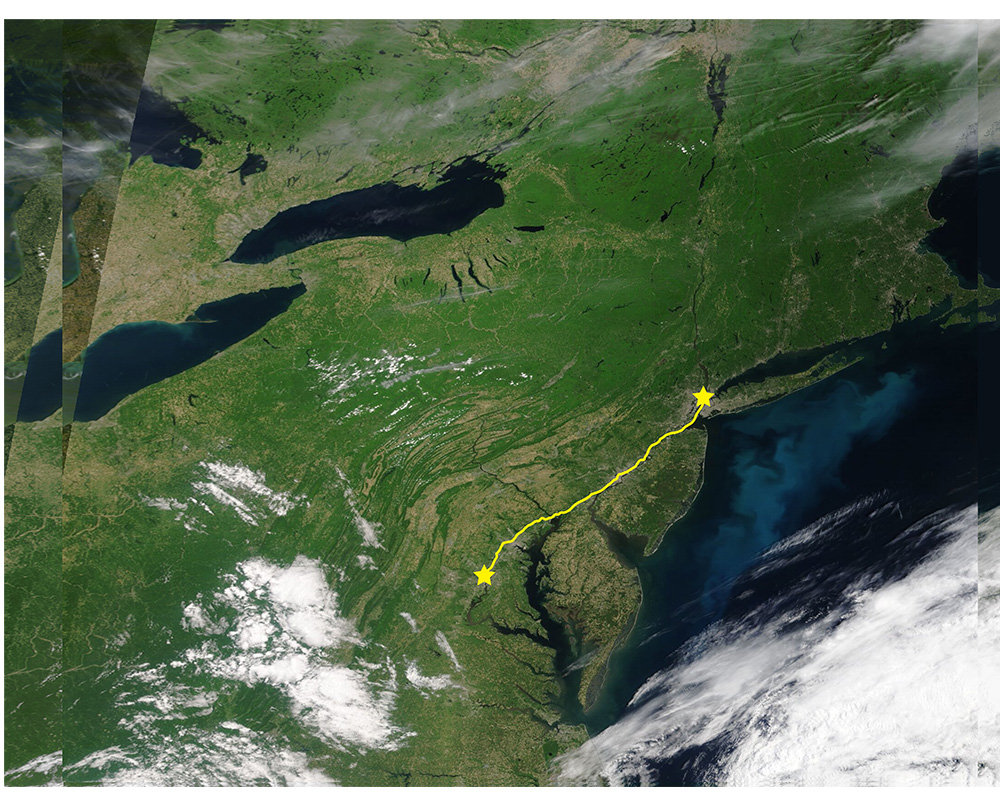
To end the walk with Rob's interview was nothing less than surreal for me, because my PhD project is in large part possible because of the work Rob has done with MODIS (the Moderate Resolution Imaging Spectroradiometer, an instrument aboard NASA’s Terra satellite). In honor of this, the base-map of the map to the right is an image from MODIS, taken at the exact moment this interview happened (well, technically it was 2 hours later. :). Following the interviews with Ross and Rob, I set out for a much less ambitious nine mile day, where I navigated from College park, through Chillum, and into Washington, D.C.-- just a few miles outside the Capitol building. This marked the 5th and final border crossing of the trip. Check out this section here!
After making it to Fairmont Street, myself and the content crew headed back to Miriam's uncle's house, where the 50 hour Livestream continued into it's second day. It was a real treat to watch some talks, but I quickly found myself needing sleep, so I headed to bed extra early, and prepared for the final day of the walk.
Tomorrow was going to be epic!!
June 3, 2026 The final day
Day #12 began with a couple miles with Miriam and Virginia, followed by a delicious smoothie from the Eat Well Juice Bar-- essential fuel for the crazy day to come! Soon, Google Maps indicated the Capitol Building was just 3.4 miles away.

Before we made it to the Capitol building, there was one more stop on my list, and it happened to be a major highlight-- the Museum of Unnatural Disasters. The organizers of this popup museum in DC had invited me to stop by on my way to the Capitol building, to check out spectacular exhibits bringing awareness to the increased natural disaster risk with a warming earth’s surface temperatures. These exhibits reminded me of so many moments from the walk-- two such being Andra 137 miles prior describing how increased ocean temperatures are supercharging hurricanes, and Kelsey 116 miles prior describing the interplay between the changing climate and increased frequency of extreme temperatures. This museum was an incredible public display of the very same science Andra and Kelsey have dedicated their careers to helping uncover. After a quick photoshoot at the exhibit (scroll halfway down the article!), I headed for a final sprint to make it to the press conference in time! Spoiler-- I made it!!!!!!
WALK COMPLETE!!!!!!!!!!!!!!!!!!!!!!!!!!!!!!!!!!! 🎉🎉🎉🎉
Washington, DC
It was surreal to arrive at the Capitol building, and even more so to see cameras set up, ready to capture the press conference event.

At the press conference, I was thrilled to give a speech, and did my best to summarize what had been truly an incredible adventure. See the speech below. :)
After my speech, I handed the nearly 300 letters (many of which were virtually sent in, and kindly printed out by Marc Alessi and Jonah beforehand ;) directly into the hands of the members of Congress. It was one of the most surreal moments of my life, and I was filled with gratitude... and exhaustion. After conveying my extreme gratitude to the folks who showed up for me, I returned to Miriam’s uncle’s house, where I refueled, and where the 50 hour livestream of science continued on strong for it's final few hours.

The Livestream was a smashing success, featuring countless brilliant speakers, and brilliant hosts. While I didn't have too much time during the walk to view it, I have since loved watching through the weather and climate science talks, and I highly recommend the stream to anyone who missed it (Link here). At 5:00 PM, June 3rd, the Livestream ended, with a recap video of my walk, incredibly put together by Miriam in just one short afternoon (see here). With that, the Livestream, and the NYC to DC walk, had concluded.
There is far too much to unpack with words here, but if you feel inclined, I've written out some reflections in the following section, as this story reaches it's close. :)
THE END
As I am writing this out right now, three months later, from my first steps, I truly can’t believe this walk happened, and I am unbelievably proud and grateful to be able to put it into a final form here on this website. It goes without saying that a walk like this takes immense privilege, and I couldn’t have done it without the endless support of my fiancée, my family and the friends who have all made many sacrifices for this to happen. To them, I extend sincere gratitude, and I will end this piece with a brief reflection selfishly for my closure, and also to thank them.
To begin, I will continue talking a bit about what happened after the Livestream ended. After the livestream ended, all co-organizers hopped on a Zoom call to reflect on the event. See image below. It was a collective sigh of relief, and a moment to celebrate. :)

After the call, some of the group, including myself, headed to the National Mall for a walk to take a moment to be present with everything that just happened. This was extremely emotional for many folks including myself, as we looked at great American landmarks, and thought about what this country has been through in its multi-hundred-year history.

As we sat and reflected, I thought of all the things that had happened on this walk. For one, I turned 24! Definitely one of my most memorable birthdays to date.

Also, I walked 270.4 miles! That's a long way, and a big personal accomplishment for me, after spending a few years battling some pretty debilitating joint pain. This was one of the first times in a few years I've been able to tackle a big physical effort like this without pain, and for that, I am extremely grateful. As a final reflection on this physical effort, I've plotted the elevation profile of the route below.
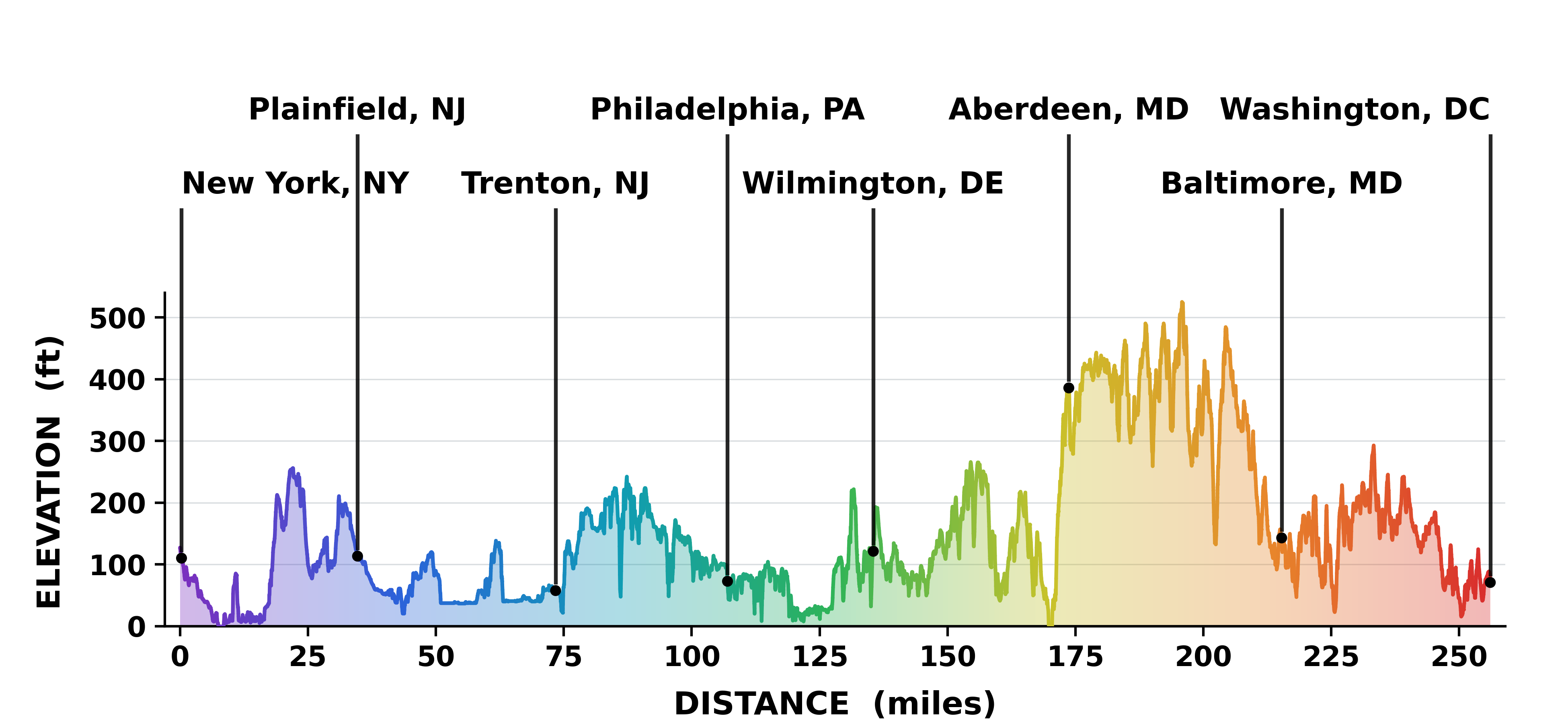
3 mile rolling median elevation from my Garmin Forerunner 95 data. :)
That moment to reflect at the National Mall was an extremely meaningful first step in processing the walk, and I have since continued processing the walk over a very busy summer, somehow finding the time to put this entire project together. For those curious, editing these videos and programming this site took around 300 hours, which is not a small amount of time. :) This time does not include the walk itself, which was around 90 hours of walking time alone, not counting stops, interviews, video editing, and stayovers. Considering the initial planning stages of this (the month leading up), the walk itself, and the editing of this website in its entirety, I estimate this was around 600 hours of work in total, which is almost certainly the hardest I’ve ever worked on a passion project. If you are still reading to this point, you are too kind for letting me take up your time, and I thank you immensely for spending time on this site. :)
I want to wrap up this site just by reflecting on a few other NYC to DC walks that helped me frame/ develop mine. One was documented in a book called American Ramble by Neil King, and I read it in its entirety after finishing my walk, and I highly recommend it for anyone interested in learning more about the historical sites and histories of the land between these two cities. Another was documented in a Youtube video by Step-n-Out. They put together an incredible documentary that I watched multiple times as inspiration. Both Step-n-Out and Neil King did the walk in part because they were facing illness (in Neil’s case, terminal), and that has really resonated with me. I was not facing a personal illness, but in many ways, the scientific community is. I think there’s something healing about going somewhere by foot. And there’s no doubt in my mind about that.
Lastly, I hope it’s obvious with this project that funding weather and climate science is an economic investment that has massive returns-- not a cost to society. Knowing how to prepare for disasters is universally a good thing for society, and I hope that is made clear with this piece.
I wrap up this reflection with a reiteration of my sincere gratitude to each and every person who partook in the project, supported me through the whole process, and/ or has taken a stand to protect the national treasure that is the weather and climate research infrastructure here in the United States. Additionally, if you have read this far, you are truly too kind for letting me take up your time, and I extend my sincere thanks to you as well.
Until the next adventure,
--Syl, signing off for now.
It turns out most of the paparazzi shots from my walk came from space. (lol!) This one's from MODIS — a refrigerator-sized camera aboard NASA's Terra satellite, 438 miles up and moving at 16,800 mph. MODIS captured this on June 2nd, my second-to-last day. To learn more about the mission, see the interview with Rob Levy at the University of Maryland stop. :)


 Call your reps


Wonderful work, I'm very inspired. This site is remarkable.